
Thinking About Removing Asbestos Siding? Read This First
In most cases, you do not have to remove asbestos siding just because your home has it. Intact asbestos cement siding holds its fibers tightly and poses little risk when left alone, and the Connecticut Department of Public Health does not require removal unless a renovation or demolition will disturb it. Removal makes sense when the siding is damaged, when you plan to reside, add on, or replace windows, or when the siding is holding up a sale. If you do remove it, Connecticut requires a licensed asbestos contractor for anything more than 3 square feet, state notification for larger projects, and disposal as special waste.
Anthony's Abatement is a family-owned, licensed asbestos abatement company based in West Hartford, and we have been removing asbestos siding, roofing, flooring, and insulation from Connecticut homes for more than 10 years. Our crews each have 10 to 15 years of field experience. Many of the siding calls we get start with a homeowner who has already been quoted for new vinyl, and this guide covers what we would want you to know before any of that work begins.
In This Guide
- First, Confirm It Is Actually Asbestos: Testing before decisions.
- Do You Have to Remove It?: When removal becomes necessary.
- Your Three Options: Leave, cover, or remove.
- Signs It Is Time to Act: When intact becomes a problem.
- What Connecticut Requires: Licensing, notification, and disposal.
- Mistakes We See Before Homeowners Call Us: Costly missteps to avoid.
- Planning Removal Around a Bigger Project: Residing, additions, and windows.
- What Removal Costs: The factors behind the price.
- Selling a Home With Asbestos Siding: What buyers ask about.
- Frequently Asked Questions: Quick answers.

First, Confirm It Is Actually Asbestos
Every decision in this guide depends on knowing what is on your walls.
What Asbestos Siding Usually Looks Like
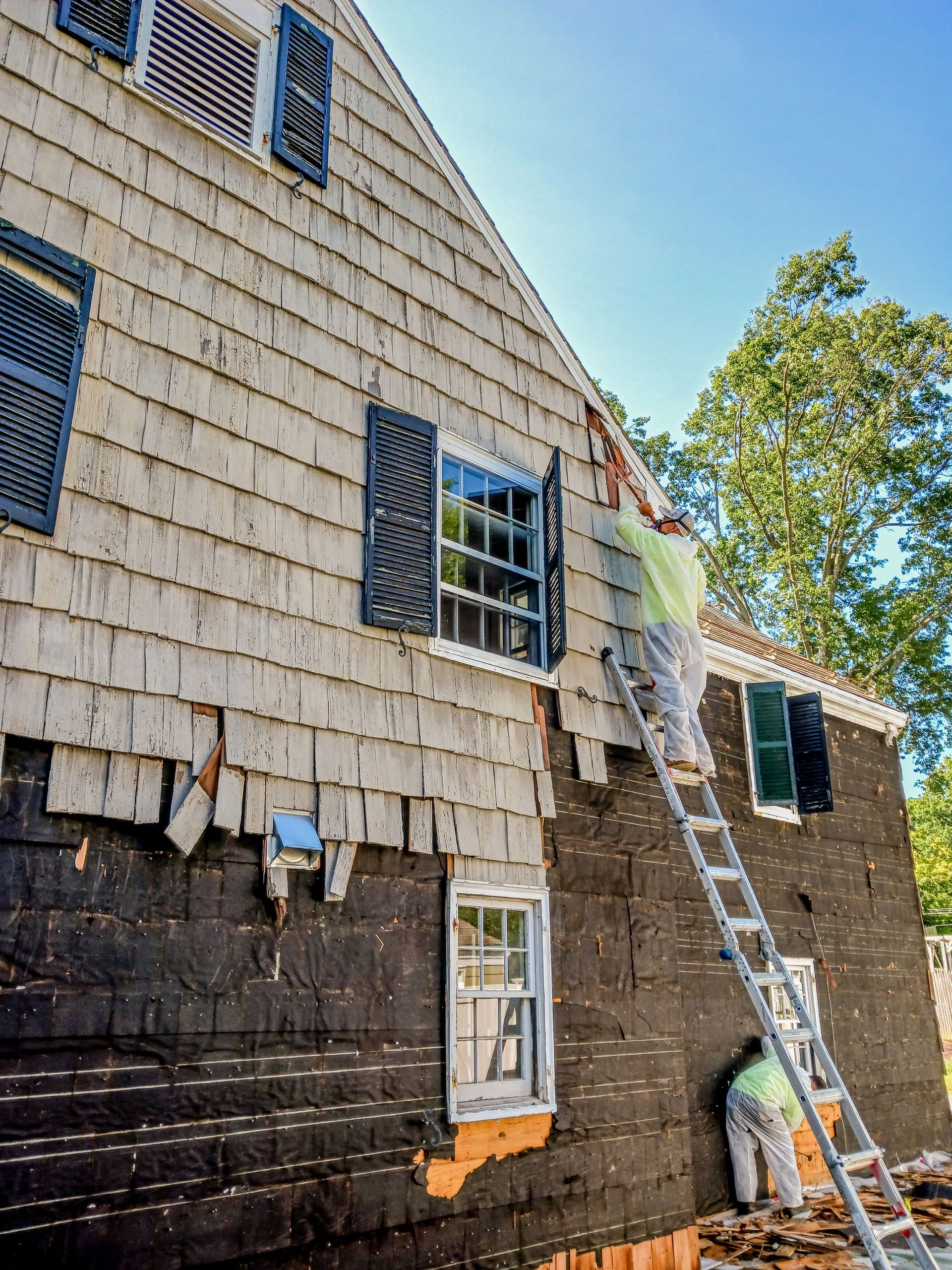
Asbestos cement siding was common on Connecticut homes built from roughly the 1920s through the 1970s. It usually comes as rigid, flat shingles about 12 by 24 inches, often with a wavy bottom edge or a stippled, textured face. It feels heavy and brittle rather than flexible. Many capes and ranches in West Hartford, Newington, Wethersfield, and Manchester still have it, sometimes painted so many times that the texture is hard to see. Our guide on whether asbestos siding is harmful covers identification in more detail.
Why Testing Comes First
Looks are not proof. Some fiber cement siding made after asbestos was phased out looks similar. A licensed asbestos inspector can take a small sample and send it to a lab, which gives you a definite answer. That answer decides whether the rules below apply at all. Learn more about our
asbestos testing services.
Do You Have to Remove It?
This is the question most homeowners are really asking, and the answer is often no.
Intact Siding Is Low Risk
Asbestos cement siding binds its fibers into a hard cement mixture. As long as the shingles are intact and not being cut, drilled, broken, or sanded, they release very little. Connecticut DPH guidance reflects this: intact siding is not automatically a hazard, and removal is not required simply because it is there.
When Removal Becomes Necessary
The situation changes when the siding will be disturbed or is already falling apart. Residing the house, building an addition, replacing windows or doors, or demolishing part of the structure all disturb the material. So does heavy storm damage. At that point, the question is no longer whether to deal with it, but how to do it legally and safely.
Most homeowners end up choosing one of three paths. The right one depends on the siding's condition and your plans for the house.
| Option | When It Makes Sense | Main Tradeoff |
|---|---|---|
| Leave it and maintain it | Siding is intact and you have no plans that disturb it | The asbestos stays, and future projects still have to account for it |
| Cover or encapsulate it | Siding is mostly intact and you want a new look | Fasteners and cutting can still disturb it, and it remains under the new siding |
| Remove it professionally | Siding is damaged, or residing, additions, or sale make removal the cleaner path | Higher upfront cost, but the problem is gone for good |
Leaving It in Place
For intact siding, leaving it alone and keeping it painted is often the most sensible choice. Paint helps seal the surface. The key is using methods that do not abrade the shingles, which is why any prep work should be planned with the asbestos in mind.
Covering It With New Siding
Installing vinyl or another product over asbestos siding is common, but it is not risk-free. Nails, screws, and cuts for trim and windows can crack the shingles underneath. It also leaves the asbestos in the wall for the next owner or the next renovation. If you choose this route, involve an asbestos professional in the planning rather than treating it as a standard siding job.
Removing It
Removal is the only option that eliminates the material. It costs more upfront, but it removes the question from future renovations, inspections, and sales. Our overview of
whether you should remove asbestos from your house covers the same decision for other materials.
Signs It Is Time to Act
Intact siding can stay in place for decades, but these signs mean it is time to have it evaluated:
- Cracked, broken, or missing shingles, especially near the ground, corners, and around doors.
- Chalky or crumbling edges where the cement surface is breaking down.
- Storm or impact damage from fallen limbs, ice, or snow piled against the wall.
- Pieces in the yard or garden beds below the siding.
- Past pressure washing or scraping, which can erode the surface and scatter debris.
- A planned project that will cut into or fasten through the siding.
If you see broken pieces, avoid handling or sweeping them up and keep kids and pets away from the area until a professional has looked at it.
What Connecticut Requires
Asbestos siding removal is regulated in Connecticut, and the rules apply to homeowners as well as contractors. The key requirements include:
- A licensed contractor for most work. Connecticut requires asbestos abatement involving more than 3 linear feet or 3 square feet of material to be performed by a licensed asbestos contractor.
- State notification for larger jobs. Projects that disturb more than 10 linear feet or 25 square feet of asbestos-containing material require a notification to DPH, filed about 10 days before work starts.
- Special waste disposal. Connecticut classifies asbestos waste as special waste, and state law prohibits putting more than 1 cubic foot of it in household trash.
- Federal rules may also apply. EPA renovation rules often do not cover an owner working on their own single-family home, but state requirements still do, and rental and multi-unit properties face additional rules.
Our guide to asbestos siding disposal explains the disposal side in more detail, including why the material cannot go to a regular transfer station.
Almost every full siding removal is far larger than these thresholds, which is why these projects nearly always call for a licensed abatement contractor. For a look at how a project runs from start to finish, see our guide to
the asbestos abatement process.
Mistakes We See Before Homeowners Call Us
Many of the siding projects we handle start after something has already gone wrong. The most common missteps:
- Hiring a siding installer without asbestos credentials to tear off and replace the old shingles as a standard job.
- Pressure washing before painting, which can wear down the surface and spray debris across the property.
- Removing one wall at a time to save money, without realizing each section still needs proper handling and disposal.
- Tossing broken pieces in the trash or a regular dumpster.
- Assuming a general home inspection confirmed it, when only a lab test can.
- Waiting until the closing timeline is tight to deal with siding a buyer flagged.
Each of these can turn a manageable project into a more expensive cleanup, especially when debris ends up in the soil around the house.
Planning Removal Around a Bigger Project
Siding removal rarely happens on its own. It is usually the first step in something else.
Residing the House
If you are replacing the siding, asbestos removal should be scheduled before the siding contractor begins. The abatement crew removes the shingles, and the siding contractor takes over once the walls are clear. Coordinating the two saves time and avoids a crew working around material they are not licensed to handle.
Windows, Doors, and Additions
Even a single window replacement or a small addition can require removing a section of asbestos siding. Plan for it early. The scope may be smaller, but Connecticut's licensing and notification thresholds can still apply. A standard window opening can easily exceed the 3-square-foot line, so ask your window installer how they plan to handle the siding around it before signing.
What Happens to the Walls Underneath
Once the shingles come off, the sheathing underneath is exposed. Older Connecticut homes sometimes have damaged boards, missing weather barrier, or rot around windows that no one could see before. Building a small contingency into your siding budget for these repairs is a smart move. Learn more about our
asbestos siding removal services.
What Removal Costs
Asbestos siding removal is typically priced by the size of the job, not a flat rate. For many single-family Connecticut homes, removal often falls in the range of roughly $8,000 to $15,000, though small partial jobs cost less and large or complicated homes can cost more. The biggest factors are total square footage, the number of stories, access around the house, the condition of the shingles, and disposal costs. For a broader breakdown, see our guide to
asbestos abatement cost in Connecticut.
Selling a Home With Asbestos Siding
Asbestos siding does not make a house unsellable, but it does come up in inspections and negotiations. Buyers may ask for testing, a credit, or removal before closing. In our experience, sellers who test early and get a written removal estimate before listing tend to have an easier negotiation than those who learn about the siding from the buyer's inspector. A lab result and a quote turn an unknown into a number both sides can work with. If you already know the siding contains asbestos, be upfront about it and keep any lab results or abatement records ready. If you are on the other side of the deal, our guide to buying a home with asbestos explains what to look for.
Talk to Anthony's Abatement Before You Start
If you are thinking about removing asbestos siding, a quick evaluation can save you from paying for the wrong project. Our team can confirm whether your siding contains asbestos, tell you whether it needs to come off, and coordinate removal with your siding or remodeling contractor if it does. Learn more about our asbestos abatement services or read our customer reviews.
Call Anthony's Abatement at (959) 202-2675 or
contact us to request an estimate anywhere in Connecticut.
Frequently Asked Questions
Share this Post
Recent Blog